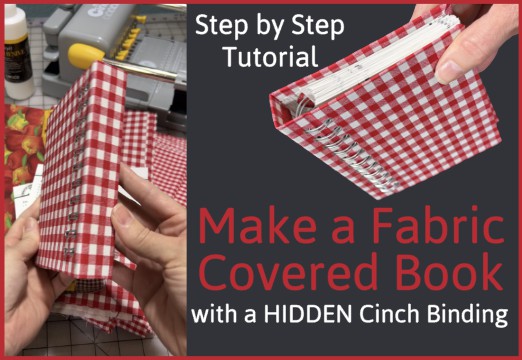
Make a Fabric Covered 4×6 Recipe Book with Cinch Binding
This is a fun book to make and makes a beautiful keepsake for 4″x6″ printed or blank recipe cards. It also would be great for pictures, a journal, paper collage art, junk journaling, cardstock scrapbooks, etc.
What makes this book special is that is it bound securely with cinch binding but the cinch binding coil is hidden so it has the smooth spine of a traditional book. This allows you to add a title or name to the book that you can read when it is on a shelf.
Read more**This post contains affiliate links. When you click these links I may make a commission on purchases made through those links. As an Amazon Associate I earn from qualifying purchases.** Please read our disclosure policy for more information.
The printable measurement sheet for this handmade 4″x6″ cinch binding book is free for my newsletter subscribers.
Fill out the form below to join my newsletter and you will instantly receive the password for the library including all of the free files I offer. You can of course unsubscribe at any time.
The file for this project in my Resource Library is #24 4×6 Cinch Binding Book.
Make a Fabric Covered 4″x6″ Book with Hidden Cinch Binding
Here are the supplies and tools needed and the instructions for making a handmade book with a fabric or paper cover and hidden cinch binding that holds 4″x6″ cards.
If the pages are card stock or similar thickness, you could probably get about 30 to 50 pages in the book. If they are thinner like copy paper or notebook paper, you might be able to get about 100 sheets in this book that is 1″ thick.
See below the supplies list for a link to the full YouTube tutorial.
Supplies and Tools
Pages for the book 4″x6″ Here are some suggestions:
4”x6” Floral printed recipe cards
4”x6” Lined Index Cards
4”x6” Blank white heavy cardstock
Fabric or paper for outside cover of the book 8″x12″
Fabric or paper for inside lining of the book 6″ x 11″
22pt. Chipboard 8 1/2″x11″
Cinch Binding machine Round holes or Square holes
Cinch coil like these in White or Gold
Straight edge/Ruler
Craft knife
Scissors
PVA Glue
Paint brush for glue
Pen or Pencil
Wire Cutters
Bone folding tool or Wood craft stick
Watch the tutorial on YouTube
Written instructions
Gather your supplies and cut your materials to the following dimensions.
If you are creating the cards to put in your book, give a margin of at least 7/16″ along the edge where the binding will go if you don’t want holes punched in part of the design or text on the card.
Cut the material for the inside and outside of the cover
Cut the fabric or paper for the outside cover to 7 1/4″x12″. If your cover material has a pattern, keep the direction of the finished book in mind. Do you want it to be vertical or horizontal?
Cut the fabric or paper for the inside cover to 5 3/4″x11″. Also keep in mind the direction you want the finished book to be to match with the pattern of the material if it has a pattern.
Cut the chipboard
Using the ruler, mark the measurements on the chipboard and carefully cut it using the ruler or a straight edge or with a Silhouette or Cricut machine that can cut through chipboard.
For the cover, spine, and back pieces of the book you need to cut four pieces of chipboard.
Front: 5″x6 1/4″
Spine: 1″x6 1/4″
Back where the cinch binding goes through: 5/8″x6 1/4″
Rest of the back cover: 4 1/4″x6 1/4″
Spacers for assembling the book: 1/2″x11″ and 1/8″x11″ (you can cut this piece into 3″-4″ pieces so you can use a few at a time).
Assemble the cover
First, test the placement of the pieces before gluing them to the material.
Place the material for the cover face down on your work surface.
Place the 1/2″ wide strip of chipboard on the left edge of the material. Place the front piece, the 5″ wide piece of chipboard next to the 1/2″ wide strip.
Place the 1/8″ spacer next to the front piece and place the 1″ piece next to it.
Move or place a second 1/8″ spacer on the opposite side of the 1″ piece and place the 5/8″ piece next to it.
Move or place a third 1/8″ spacer on the opposite side of the 5/8″ piece and place the 4 1/4″ piece next to it.
Move the 1/2″ spacer to the end to make sure the material for the cover is long enough.
Move the 1/2″ spacer to the top and the bottom of the chipboard cover pieces to make sure the material has the correct amount of margin around the cover pieces.
Glue the pieces together
If your cover and inside material is measured exactly, use the spacer pieces for exact placement. If it is a little larger than it needs to be you can place the cover pieces in the center of the material and use the spacers and trim down the material to 1/2″ after gluing the pieces to the material.
Working in the same order that you test fit the pieces, apply the PVA glue to the first piece of the cover chipboard with a paint brush. You want enough glue that it doesn’t dry before you put the chipboard on the material but not so much that it soaks through the fabric or makes the paper wrinkle. Place it glue side down on the fabric using the 1/2″ spacer to place it 1/2″ away from the left edge of the material and 1/2″ down from the top and up from the bottom edges.
Use the 1/8″ spacers to space out the cover pieces and the 1/2″ piece or your straight edge to make sure the cover pieces are all straight. Remove the spacers after the cover pieces are glued in place.
Mark and trim off the excess material if needed.
Apply glue across the top and the left and right side of the chipboard pieces about 1/2″ wide.
Fold the material along the edges and press it into the glue.
For the corners, there are a few ways to make the ends look finished.
One option: Fold the top edge of the material down, fold the end that extends past the edge down at an angle so the top edge meets the end of the cover, repeat for the bottom edge, then fold the end over the inside of the cover.
Second option: Before folding the top or edge, fold the corner in on top of the chipboard as far as it will go. Repeat for all four corners. Then fold the edges in. This is the method I used in the video.
Third option: Trim off the corner of the material about 1/16″ from the corner of the chipboard. Fold the edges in. This removes the excess material completely instead of folding it away.
Place the inside cover material on top of the inside of the cover to make sure it is the correct size and evenly overlaps the material from the cover.
Apply glue to the chipboard on the inside of the cover and along the edge of the material of the outside cover of the chipboard where the inside material will overlap. Be sure to brush glue into the crevices where the 1/8″ spacers were.
Place the inside material and smooth it down onto the glued surface. Use the bone folding tool or wood craft stick to press the material down into the 1/8″ crevices. This will allow the book cover to bend open and closed.
Let the cover dry completely. It is optional but I laid the assembled cover out open on my table and covered it with parchment and weighted it down with a book to make sure it dried completely flat.
Optional: Decorating the cover with heat transfer vinyl
If you want to decorate the front, back, or spine of the book with heat transfer vinyl, this is the time to do it.
Measure the area you want your design to go, cut your design (be sure to mirror the image so it cuts correctly), apply the heat transfer vinyl to the cover with an iron or heat press.
Punching the holes in the cards
Use an extra card or cut a piece of scrap paper down to 4″x6″ and do a test punch in your machine. You want the holes to be spaced evenly across the top of the card. I needed to pull out one of the levers on my machine so it didn’t punch a partial hole at the end. My cards ended up having 11 holes punched evenly across the top.
Divide the cards into groups that you can punch in your machine. The number of cards you can punch at one time will depend on the thickness of your cards.
Punching the holes in the finished cover
You are punching holes in two parts of the book cover at once. Remember, this is a hidden binding so you won’t be punching holes in the 1″ spine of the book, it will be in the two pieces that make the back.
Fold the bigger back piece in so it is flat against the inside of the cover. It will be uneven, not reaching the outer edge of the front part.
Move the guide on the cinch machine out 1/8″. Since the cover of the book is 1/4″ larger than the cards, this will center the holes in the book cover so the cards are centered in the book. Pull out any levers past the 11 so they don’t accidentally punch your cover. Do a test punch on a 6 1/4″ card or scrap piece of paper to double check.
With the back cover folded in, place cover into your machine with the folded edge in and the 5/8″ strip facing up.
The cover should fit in a Cinch binding machine if you used the correct thickness of chipboard but it will be tight. Be sure to press it in all the way so the holes are centered in the 5/8″ strip.
Press down on the handle firmly and quickly so it punches clean.
Measure and trim the cinch coil
Put the ends of the coil through the holes in one of your cards lining up the first point on the coil with the first hole in the cover. Using the wire cutters, trim the coil off just past the last hole.
Assemble the book
Put all your cards in the order you want them to be in the finished book.
After it is cinched, the opening of the coil will be behind the cards but inside the back of the cover. To do this, with the cards stacked in order, turn the cards over and put the points of the coil through the holes in the cards from the back.
Then, fold the back of the cover along the seam in between the hole punches so it is inside out. Put the cover onto the points of the coil with the longer, inside part of the cover towards the front of the cards.
With the cover and cards in a stack and the opening of the coil facing away from the stack, place the coil in the cinch part of the machine. Give it firm pressure to press the coil closed.
Release the machine and fold the cover around your cards.
The book is complete.
Thank you for following along. I hope this inspires you to make this special book.
If you do, I would love to see it. Tag me on Instagram @pastrychefm
Best,
Megan